
Why Your Qlik Deployments Keep Breaking
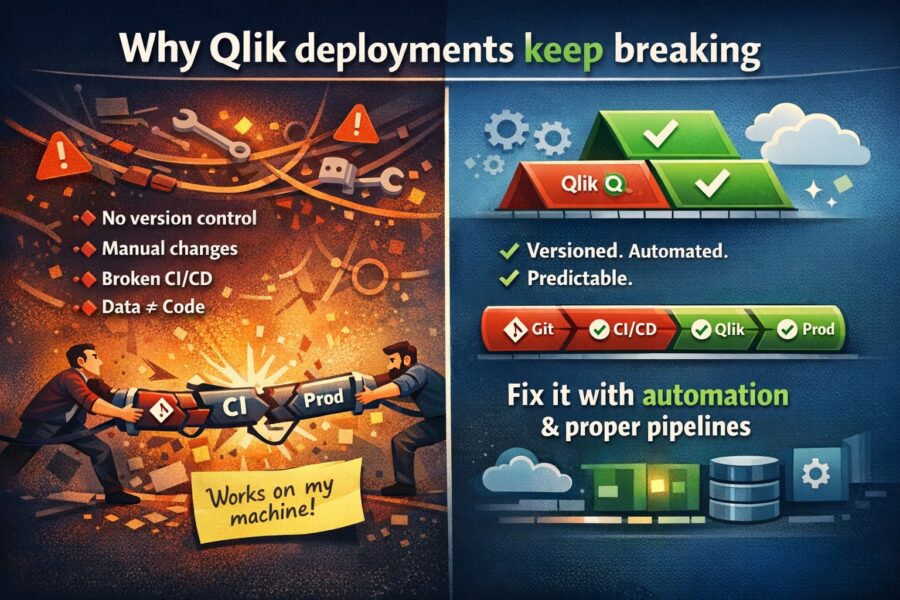
Every Qlik team has a deployment horror story. Maybe it was the app launch load script bug that decided to release an app to production with a broken ...


Digital transformation has forced management to rethink current business models to accelerate the digitalization process and update analytics tools. However, this process is not fast.
Now, data collection and management are a usual business practice. Despite this, there is a high probability that the data is scattered, fragmented, and uncleaned. Inaccurate data and flawed data management can play against business and hinder effective decision making and development. Therefore, this leads the company to poor performance indicators.
Master data management (MDM) plays an important role in enabling intelligent business processes (providing datasets with the correct structure, hierarchy and management). MDM manages critical data across multiple sources, channels, and departments. Master data management implementation requires a well-defined strategy. Let’s look at several important steps in developing a successful master data management strategy.
The master data vision must be consistent with the whole business vision. This contributes to the success factors identification and objectives achievement in functional, technical and financial terms. First, the MDM economic model should answer the questions “Why?”, “How?”, “Who?”. This will help identify business pains and data problems. Solving these problems at early stages ensures all business stakeholders support and approval.
Using a multiphase approach to an MDM strategy can be more effective by working with a minimal set of phase objects and scaling it into the next phase. Ignoring such a detailed model when building an MDM solution further can lead to the master data creation from isolated and disparate sources.
Companies should clearly define their target architecture, existing technologies, and select a system integrator. Effective MDM technology must support real-time analytics and operational processes to align with the overall the organization’s IT architecture and ecosystem.
Business owners need to manage data across all processes and departments. The effective master data management process should identify, measure, record and correct data quality problems in the source system. A formal data governance model should include detailed business rules, governance mechanisms, controls, and data compliance.
The strategic plan can demonstrate the steps implementation in accordance with the business objectives. This prevents MDM solutions from failing as a result of structural flaws that damage the entire data system.
First, it is necessary to determine the parameters and indicators that determine the data management success throughout the entire life cycle. MDM stakeholders can be from different organization parts and have different goals. In that situation, it makes sense to check ROI in stages. For example, when custom domain is implemented into a strategy, you need to check your ROI in terms of increasing cross-selling, sales, etc.
The MDM strategy requires analysis before implementation and monitoring afterwards. All employees, company’s management and stakeholders must work together to achieve their business goals.
All company staff must be trained in how to format, enter, store and access data. Regularly checking configuration, installation, data models, data management tools, hierarchy helps to avoid problems.
Every Qlik team has a deployment horror story. Maybe it was the app launch load script bug that decided to release an app to production with a broken ...
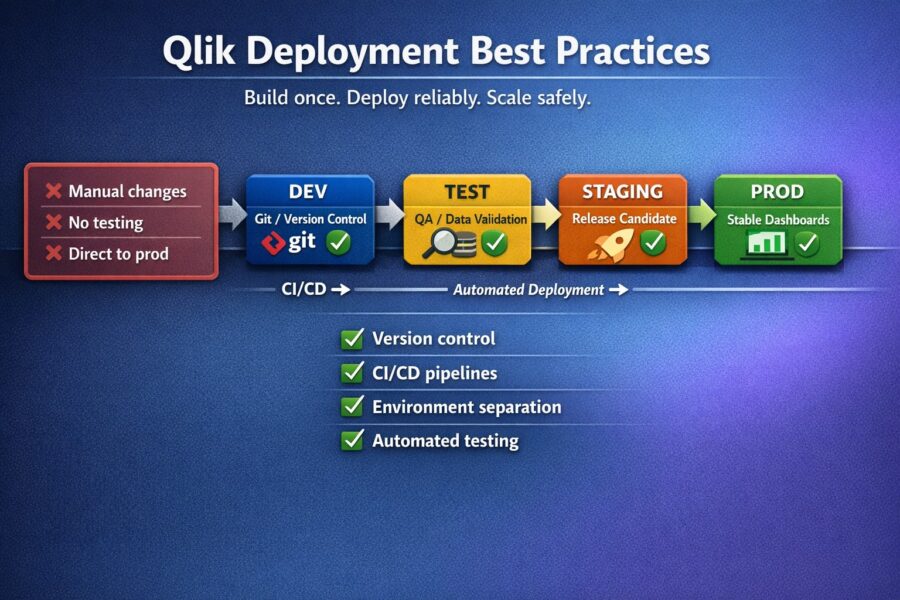
Are you the type of person who deploys Qlik apps by simply exporting a QVF, renaming it, and then importing it to your target environment? If so you&#...

During a briefing on the Iraq War, Donald Rumsfeld divided information into 4 categories: known known, known unknown, unknown known, unknown unknown. ...


No comments yet.
Leave a comment