
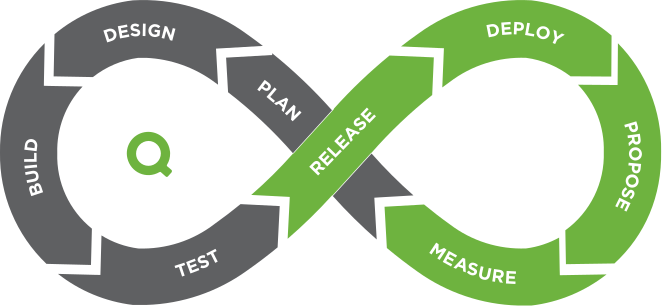
The Constraint Always Moves
The most expensive assumption in analytics is that a solved bottleneck stays solved. Theory of Constraints taught this on factory floors decades ago. ...


In recent years, we have observed the development and emergence of new technologies that have significantly facilitated and provided a more comfortable life for people and business. Artificial Intelligence, machine learning and data science are key ingredients in the development of the cutting-edge technologies available today. Their development has significantly affected the operational capabilities in various industries and the improvement of performance indicators through the availability of quality information and data.
This technological revolution has also affected the financial services industry. Startups have emerged that use Artificial Intelligence and data science to predict cash flows, assess creditworthiness and detect fraud. In turn, this allows companies to gain a competitive edge by making better data-driven decisions, automating tasks etc. Global AI spending is projected to exceed $110 billion by 2024, double the amount in 2020.
Lending
An important application of AI in the financial sector is credit scoring. Banks and financial companies are using AI to accurately assess potential borrowers. In the process of determining the creditworthiness of a particular customer, AI and machine learning use advanced classification algorithms with various explanatory variables (demographics, income, savings, transaction history, credit history, digital footprint, etc.). This allows organizations to make an informed decision on granting a loan, and borrowers without extensive credit will be able to receive a loan.
Advanced algorithmic trading
Artificial Intelligence uses methods such as evolutionary computing, deep learning, and probabilistic logic. Such methods help traders systematize the implementation and development of a strategy for future transactions, as well as predict the result. AI also provides the ability to track and assess risks, adjust or close positions, depending on the needs of the user, completely automatically. AI and machine learning enable competitive prices, liquidity management and process optimization. Also, AI systems use NLP (Natural Language Processing), which gives traders the ability to determine user sentiment using Twitter, Reddit, news, etc. as sources.
Fraud Prevention
There are machine learning algorithms that can detect and prevent fraudulent transactions. Traditional methods of dealing with fraud involved the existence of coded rules. In this case, there was a risk that fraudsters would discover these rules and use them for their own purposes. New AI-based solutions are able to adapt to new patterns in transactional data (past behavior, location, spending patterns, etc.). This makes it possible to create a safer and more secure system that can detect anomalies and trigger an alert.
Personalized banking experience
Chatbots have exploded in popularity in recent years. Banks are using the power of AI and NLP methods to better understand customer needs. Also, in the process of achieving financial goals, they use large amounts of data to analyze consumers’ purchasing habits and subsequently provide them with individual financial recommendations.
Process Automation
AI has many functions, however, the most important is automation. AI-based systems can easily extract information from documents, digitize it, process it, etc. Optical character recognition (OCR) significantly improves the efficiency of labor-intensive processes. The use of AI provides financial institutions with the ability to effectively manage, control and minimize risks.
So, Artificial Intelligence, machine learning, and data science are making the financial industry secure and resilient, and providing a safe, efficient, and transparent way of doing business
The most expensive assumption in analytics is that a solved bottleneck stays solved. Theory of Constraints taught this on factory floors decades ago. ...
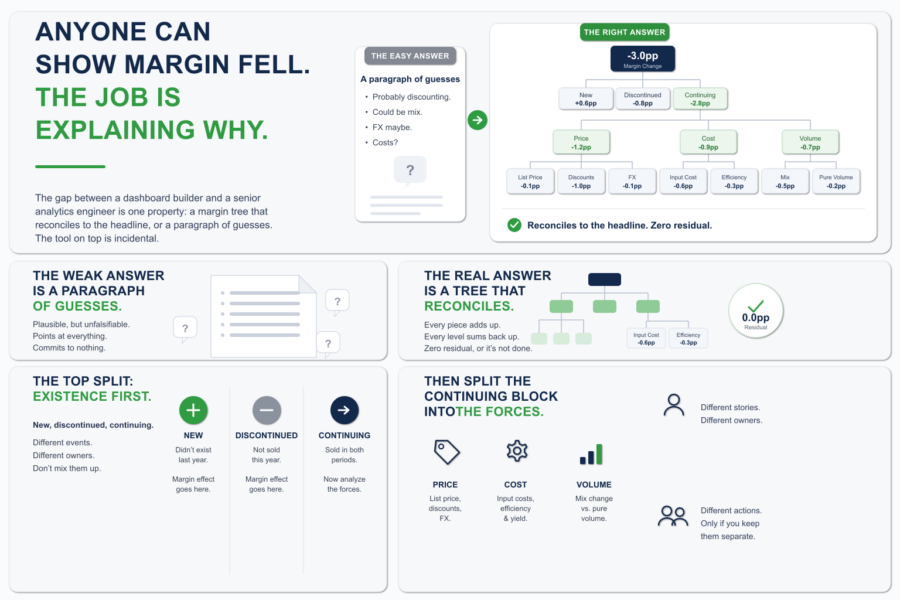
Margin is down three points. The CFO knows that already. The dashboard told them, the board deck told them, the number is not in dispute. What they wa...
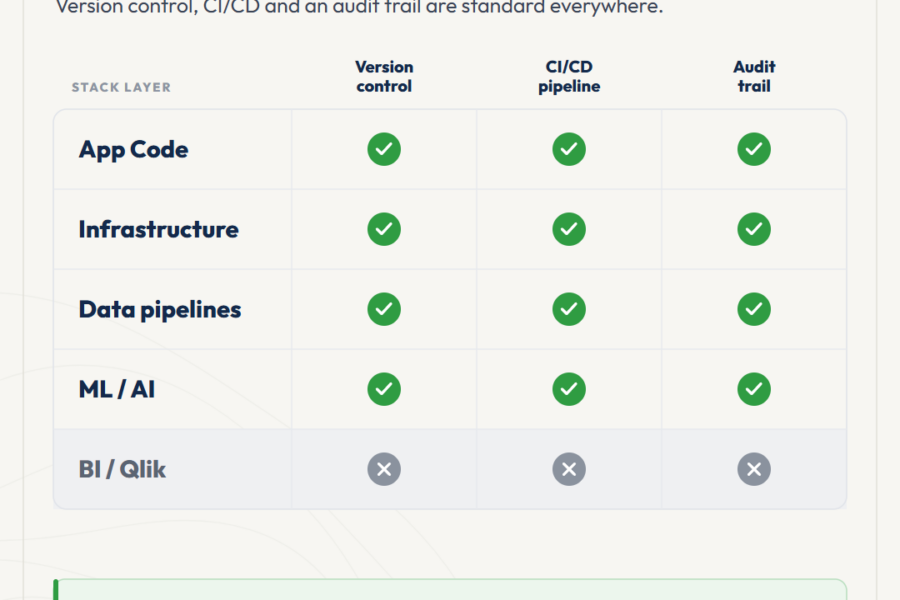
At some point, every BI team that grows past three or four developers hits the same moment. Deployment coordination starts eating senior time. Small i...


No comments yet.
Leave a comment