
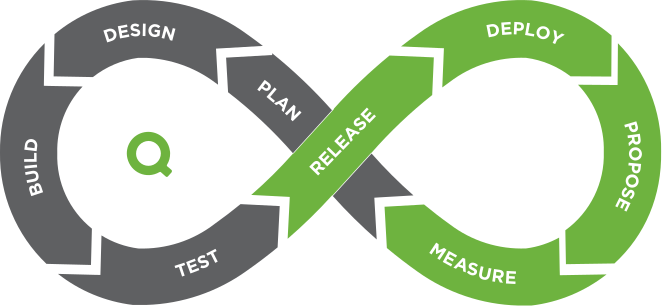
The Constraint Always Moves
The most expensive assumption in analytics is that a solved bottleneck stays solved. Theory of Constraints taught this on factory floors decades ago. ...


Nowadays, it is important to create a sustainable business in accordance with the rules of sustainability and sociality. Until 2030, the UN has identified 17 goals and 169 targets for sustainable development, which are a benchmark for modern business. Modern business strategy must include ESG goals.
ESG (environment, social, governance) – is a management principle that helps to achieve the involvement of the company in solving environmental, social and management problems. Such non-financial indicators allow to explore business activities through social and ethical relationships with the environment.
The approach to implementing sustainability principles may differ depending on the business area, its profitability and scale, the number of employees, etc. However, the basis and principles of ESG are common. Small and medium-sized businesses often postpone the transition to sustainable development, explaining this by the fact that they don’t have enough funds for implementation. Also, the non-obviousness and unpredictability of the transition effect stops the leadership on the transition path. However, experts argue that sustainable development will bring benefits.
ESG – key factors that determine the level of sustainability and ethical impact of an investment in a company. Investors use ESG standards to monitor the company for: nature conservation (environmental), management of relationships with employees, partners, customers, society (social), remuneration, audit, internal control (corporate). There are financial institutions and funds that monitor ethically sound companies and check them before investing.
ESG includes
Environmental factors:
Social factors:
Corporate Governance:
ESG Benefits:
ESG data is data about the environmental, social and governance company performance. These include: the amount of water consumed, the amount of CO2 emissions, the number of employees, the gender ratio, etc.
Accurate, transparent and actionable data are essential to create and effectively monitor a sustainable development strategy. Many companies store their environmental impact information in spreadsheets. This complicates and extends the process of extracting reports and analysis. However, Qlik simplifies data analytics and connects the sources of sustainable development into a single dashboard. This makes impact as easy to measure as sales, profits, and other KPIs.
DataLabs is a Qlik Certified Partner. A high level of team competence and an individual approach allows to find a solution in any situation. You can get additional information by filling out the form at the link
The most expensive assumption in analytics is that a solved bottleneck stays solved. Theory of Constraints taught this on factory floors decades ago. ...
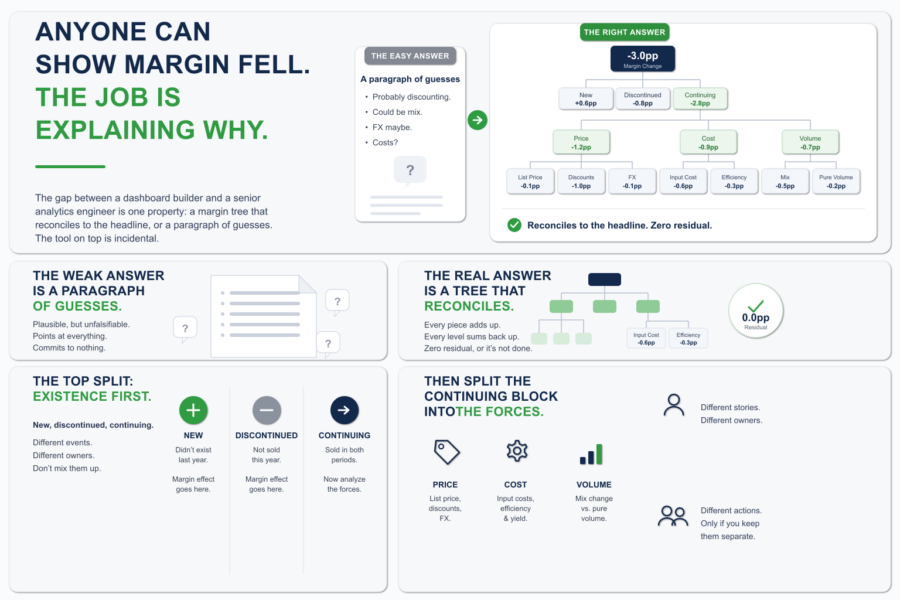
Margin is down three points. The CFO knows that already. The dashboard told them, the board deck told them, the number is not in dispute. What they wa...
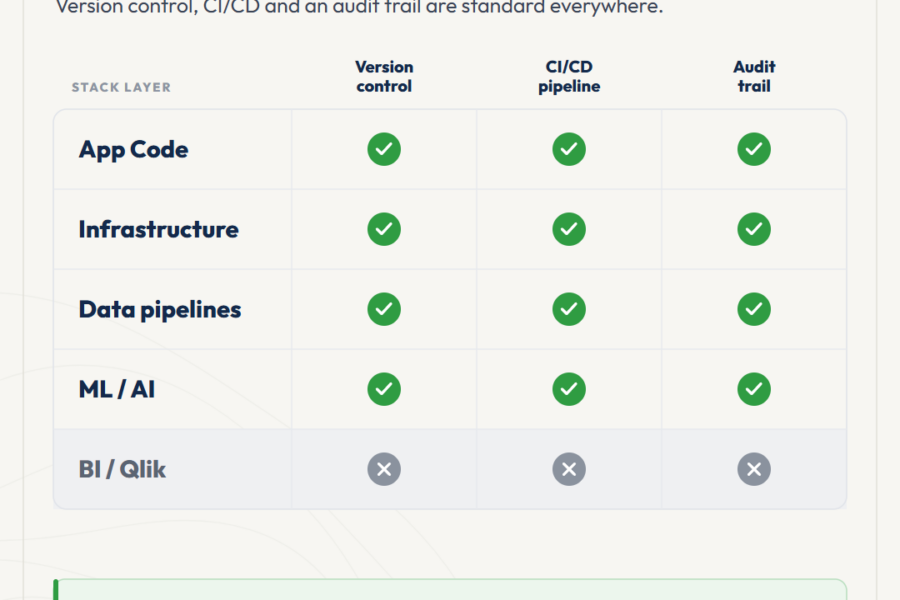
At some point, every BI team that grows past three or four developers hits the same moment. Deployment coordination starts eating senior time. Small i...


No comments yet.
Leave a comment